
When Everyone's Building AI Agents, Build the Pickaxe
The AI gold rush is real. But here's the thing - most founders are panning for the same gold in the same streams.

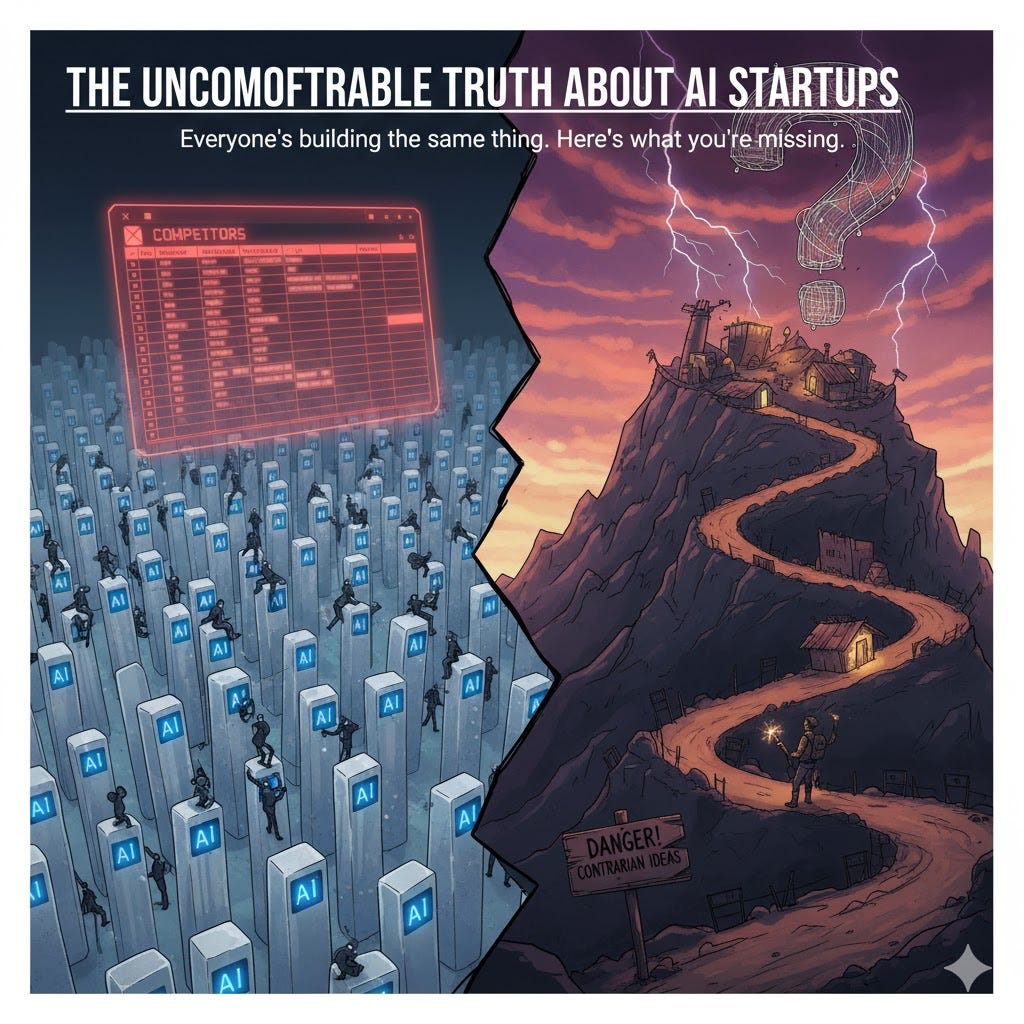
Last week, I was talking to a founder who’d just killed their AI customer service startup. Not because it didn’t work. Because 47 other teams were building the exact same thing. The VCs he pitched literally had spreadsheets comparing features across competitors. When your startup becomes a row in someone’s Excel, you’ve already lost.
The smartest founders right now? They’re not chasing what’s hot on Twitter. They’re finding the problems that make other founders uncomfortable. The ones that feel a bit... dangerous.
Why did Door Dash win when 12 other food delivery startups died?
You know what killed most food delivery startups in 2014? They all went “full stack” - cooking food, running kitchens, managing logistics. DoorDash said nah, we’ll just deliver. Everyone called them unambitious.
Today they’re worth $65 billion.
Here’s what’s happening in AI right now: Everyone’s hiring forward deployed engineers. Everyone’s chasing the same enterprise verticals. Everyone’s building on the same “proven” playbooks.
How do I know if my idea is contrarian or just bad? Contrarian ideas have desperate early customers. Bad ideas have interested observers. If someone’s willing to use your broken MVP today, you’re onto something.
The opportunity? Do the opposite of what everyone else is doing.
“If you only want to work on things that are hot, you’re going to find yourself working on derivative ideas with 100 competitors.”
How did a “terrible” idea become worth $7.5 billion?
Hardware startup? Strike one. Selling to local governments? Strike two. Based in Atlanta? Strike three.
Garrett Langley built Flock Safety anyway. VCs calculated the total addressable market at $60 million tops. Too small, they said. Too hard, they said.
Today Flock Safety solves 10% of all reported crime in America. Valuation: $7.5 billion.
The lesson isn’t “ignore VCs” - it’s that spreadsheet logic misses human desperation. When kids are getting kidnapped and cars are getting stolen, nobody cares about your TAM calculations. They care about catching criminals.
What if VCs won’t fund my weird idea? Perfect. Less competition. Flock Safety almost didn’t get funded. Bootstrap to early revenue, then watch VCs suddenly discover your “category.”
Which rules should you actually break?
Forget the framework everyone’s using. Here’s what actually predicts startup success:
Would you pay for this if it was illegal? Not suggesting you break laws. But Uber was technically illegal. So was Airbnb in most cities. When humans want something badly enough to risk fines, you’ve found real demand.
Are the current laws just... dumb? Taxi medallions made sense before smartphones. Securities laws make less sense for blockchain. Find regulations written for a world that no longer exists.
Does explaining your idea make you slightly uncomfortable? If everyone immediately gets it and loves it, you’re already too late. The best ideas sound dangerous at first. OpenAI was mocked by AI researchers for years. SpaceX was Elon’s “vanity project.”
Should I really ignore successful playbooks? Don’t ignore them. Invert them. If everyone’s going vertical, go horizontal. If everyone’s B2B, consider B2C. The playbook becomes the problem.
What does this mean for your AI startup?
The two-year AI gold rush window is closing. The obvious ideas are taken. But here’s what’s opening up:
Codegen replacing humans: Not augmenting. Replacing. One YC company built an AI forward deployed engineer that does installations in minutes, not weeks.
Industries everyone thinks are “too hard”: Government contracts. Healthcare compliance. Financial regulations. The moats that kept big companies safe are now attack vectors.
Business models that shouldn’t work: Compound startups are supposedly impossible. Campfire is killing NetSuite anyway by building everything at once with AI.
How do I validate fast without building everything? Sell first, build second. Get 3 customers to commit before writing code. Their desperation level tells you everything.
What’s the one assumption everyone’s making that’s wrong?
Here’s what I want you to think about: Look at your competition. What are they all doing the same? That’s your opportunity.
The next unicorn is hiding in the idea that makes everyone else nervous. Not just intellectually uncertain - actually uncomfortable. The kind where your friends at parties say “that’s a tarpit idea” or “that’ll never scale.”
What if I fail because I zigged while everyone zagged? You’ll fail faster and cheaper than the 97 companies fighting over scraps in the “obvious” market. And you’ll learn something nobody else knows.
Remember: Nine out of ten people might tell you you’re crazy. But that one person who gets it? They might be your co-founder, your first customer, or your first investor.
Ready to level up your contrarian thinking?
Building something everyone thinks is impossible? Let’s talk strategy. I work with founders navigating the space between “that’ll never work” and “why didn’t I think of that.” Book a session: https://topmate.io/chalkmeout
YC Startup Spotlight
Giga ML
AI forward deployed engineer that automates enterprise integrations. Use when you need to onboard enterprise customers in hours, not months.
-
Reply and tell me: What’s the one thing everyone in your industry believes that might be completely wrong?
Until next time, keep building what others won’t.
Narayanan
Spot on. Love the 'broken MVP' test. So tru for dev.